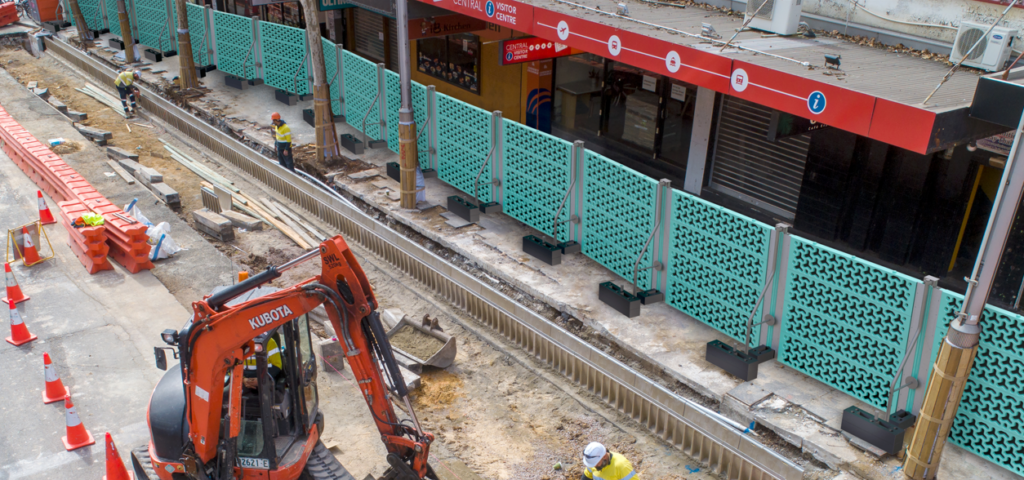
Construction noise restrictions in Australia vary by state, territory, and local council, usually setting permitted construction hours and, in some cases, noise limits to control excessive noise from building work. For builders, contractors, developers, and other construction professionals, that means compliance requirements can change depending on where the site is located and which authority is responsible for managing noise nuisances.
Local councils and government authorities may also impose their own construction noise rules in response to ongoing complaints or site-specific conditions, which can differ from broader state or territory requirements.
While it’s important to check the local noise regulations before starting construction, these rules are designed to balance urban development with community health, and understanding them helps you avoid breaches, complaints, and delays. Below is a quick overview of construction noise restrictions around Australia, including permitted working hours, responsible authorities, local variations, and key considerations for excessive noise management.

New South Wales
The NSW Environment Protection Authority (EPA) is responsible for setting and enforcing construction noise limits, with support from local councils across the state.
In New South Wales, construction is generally permitted on Saturdays between 8 am and 5 pm, with most construction sites not allowing any work on Sundays or public holidays; however, specific hours may vary depending on the local council, development consent, and development conditions, with some projects potentially having extended Saturday hours or limited Sunday work with approval.
Standard Saturday hours: Most construction sites operate on Saturdays from 8 am to 5 pm. No Sunday work: Typically, no construction work is allowed on Sundays or public holidays. Check development consent: Always consult the development consent for the specific construction site to confirm permitted hours. Exceptions for certain work: Some low noise activities like deliveries or essential maintenance may be permitted outside standard hours with proper notification.
- Monday to Friday from 7 am to 6 pm, and
- Saturday from 7 am to 5 pm.
There’s to be no construction work completed on Sundays or public holidays; however, there may be individual development consent or permits allowing certain works. Certain activities that generate persistent or disruptive noise may also be subject to local noise abatement period requirements depending on the site location and council conditions.
Victoria
When it comes to construction noise in Victoria, businesses must comply with the general environmental duty (GED) stipulated in the Environment Protection Act 2017. Many local councils also have their own requirements for noise management at construction sites, and councils investigate valid noise complaints under the Act.
As a general rule, construction noise in Victoria is generally restricted to normal working hours:
- Monday to Friday from 7 am to 6 pm, and
- Saturdays from 9 am to 1 pm.
When it comes to the construction of large-scale residential developments in non-residential zones, the normal working hours extend to 7 am to 1 pm on Saturdays.
This may include managing noise from temporary site infrastructure such as generators, air conditioning equipment and refrigeration equipment used during construction activities.
Queensland
In Queensland, construction noise is regulated under the Environmental Protection Act 1994. The local council is responsible for enforcing construction noise standards unless the construction work is being carried out by a State or local government entity. When making a noise complaint, it’s worth keeping a record of the times and dates of incidents to support your case with the local council or the EP Act’s default standards.
If the local council hasn’t prescribed its own noise standards, the default noise standards in the EP Act will apply instead, including rules for different noise types. Under the Environmental Protection Act, building work being carried out by a registered contractor or builder, or under an owner-builder permit, can take place:
- Monday to Saturday from 6.30 am to 6.30 pm.
Building work that doesn’t create clearly audible noise, like electrical work and painting, can be conducted at any time outside of these hours.
Australian Capital Territory
In the ACT, noise is regulated under the Environment Protection Act 1997 and the Environment Protection Regulation 2005. The ACT is divided into various noise zones, each with its own noise standard for day and night-time.
When it comes to construction and building work, it’s understood that these types of activities are likely to produce noise levels over the acceptable standard. So long as these activities comply with certain conditions, they can be conducted in residential areas, but unreasonable noise is still restricted even where limited exceedances are allowed.
For building work conducted in residential areas, if it’s likely to be completed in less than 2 weeks, this activity may exceed noise standards from:
- Monday to Saturday from 7 am to 8 pm, and
- Sunday and public holidays from 8 am to 8 pm.
If the work is scheduled to take more than 2 weeks, this activity may exceed noise standards from:
- Monday to Saturday from 7 am to 6 pm, and
- No noise exceeding the standards is allowed on Sundays and public holidays.
In the ACT, noise exceeding the standards may only occur for 40 hours in any 8-week period.
For any construction sites located in industrial, city and town centre areas, construction activity may exceed noise standards on any day between 6 am and 8 pm. Different noise standards may apply for certain activities if a residence:
- Borders non-residential land, where compliance may be assessed at the property boundary (EG. a residential block adjacent to local shops), or
- Is located on non-residential land.
South Australia
In South Australia, noise from construction sites is managed by the local council in accordance with the Local Nuisance and Litter Control Act 2016.
Managing construction noise means minimising noise impacts from heavy machinery and power tools, so these activities should only occur between the hours of 7 am and 7 pm Monday to Saturday. This applies to noise that results from:
- Demolition work, site preparation work and building maintenance or repair work,
- The operation of vehicles within, entering or leaving a construction site, and
- Any activities at, or within the immediate vicinity of a construction site, of persons who perform work at the site, or activity connected with work at the site.
At EPA-licenced facilities, the SA EPA is responsible for managing issues associated with noise from construction.
Western Australia
In WA, the Environmental Protection (Noise) Regulations 1997 provide guidance in relation to construction noise. Essentially, construction work must be carried out between 7 am and 7 pm Monday to Saturday. Construction work is prohibited on Sundays and public holidays.
If your site is likely to produce noise outside of daytime hours or exceed permitted background noise levels, which often determine applicable decibel limits, you must submit a Noise Management Plan to the Chief Executive Officer (CEO) of the Department of Water and Environmental Regulation.
The noise restrictions and regulations detailed here should serve as a general guide only. Before starting any construction work, be sure to check with the relevant local council or authorities for more accurate and up-to-date information.
Tasmania
The Environmental Management and Pollution Control (Noise) Regulations 2016 set out the regulations for construction work in Tasmania.
Generally, construction noise is limited to:
- Monday to Friday from 7 am to 6 pm,
- Saturday from 8 am to 6 pm, and
- Sunday and public holidays from 10 am to 6 pm.
Local councils may have their own restrictions and regulations regarding construction noise. These rules help regulate noise and reduce the long-term health and wellbeing impacts of prolonged exposure to excessive sound.
Northern Territory
In the NT, you’ll usually have to submit a Noise Management Plan (NMP) to the NT EPA if your construction project is likely to generate noise that won’t comply with the Waste Management and Pollution Control Act 1998 or the recommended assigned noise levels included in the guideline.
If you’re planning on undertaking normal construction, the recommended standard hours of work are:
- Monday to Saturday from 7 am to 7 pm, and
- Between 9 am and 6 pm on Sundays or public holidays.
Blasting work on construction sites must be conducted between:
- Monday to Friday from 9 am to 5 pm, and
- Saturday 9 am to 1 pm.
No blasting is permitted on Sundays or public holidays.
There may be some instances where construction work is completed outside of the specified times, so it’s essential to take reasonable steps to notify neighbours and people nearby of the upcoming work and minimise noise where possible, particularly near an affected building. Some noise issues are easily resolved by speaking with neighbours first before escalating matters. For example, if out-of-hours work is unavoidable, letting nearby residents know in advance can help reduce complaints.
Construction noise control solutions with Control Hire
At Control Hire, we specialise in a wide range of noise reduction solutions for construction sites and building sites. Our all-in-one noise control wall uses patented technology that makes it the most effective noise control wall on the market. For commercial and industrial projects, noise levels that exceed standards can lead to fines and other enforcement action. Get in touch with the team at Control Hire to chat more about your project and find a noise control solution for your next construction site.