
Dust management continues to be a significant challenge within the construction industry, especially in densely populated areas. But thanks to continual innovations and evolving technologies, dust suppression systems are only getting better.
Here’s an overview of the latest cutting-edge solutions when it comes to dust suppression and management.
Atomizing nozzles
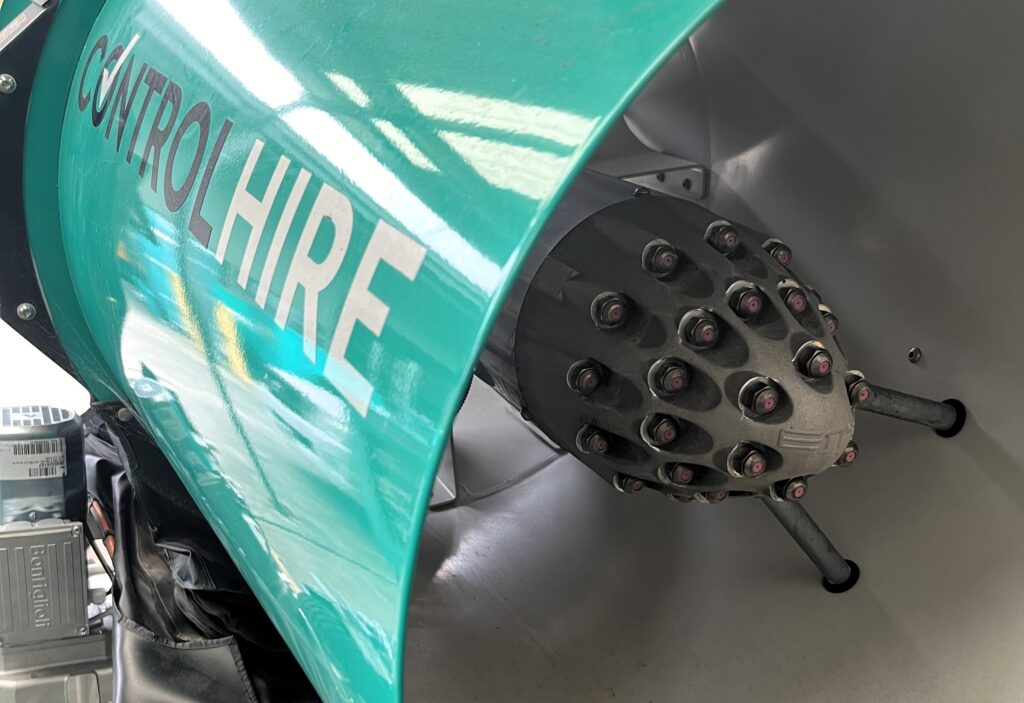
Dust particles are often produced as a result of various construction and industrial activities. Not only can dust particles pose a potential hazard to site workers, but they can also impact the surrounding community and environment. To control the amount of dust produced on construction sites, dust suppression systems, like fog lances and dust cannons, use air atomising misting nozzles for dust suppression.
The design of the nozzle in particular is crucial for atomisation. Atomising nozzles are engineered to create very fine droplets by forcing the liquid through a small opening or by using other mechanisms like air assistance. As the pressurised liquid passes through the nozzle, it undergoes rapid acceleration and turbulence, which causes it to break up into small droplets.
The fine droplets produced by the nozzle are then dispersed into the air, forming a mist or fog-like cloud. This cloud of droplets effectively captures dust particles floating in the air. As the mist of droplets collides with dust particles, it causes them to stick to the droplets and become heavier and drop to the ground. This process effectively removes the dust particles from the air, reducing airborne dust levels. This helps to clear the air and suppress dust over a designated area.
This type of fine mist spray can’t be achieved with a regular garden hose, so it’s important to invest in the proper technology to ensure effective dust control on site. Many of these dust control solutions are also fitted with an adjustable spray action that can be modified to suit the site.
Silica monitoring

You can’t mention dust without touching on the harmful effects of silica dust in particular. Workplaces, including construction sites, are required to implement effective dust control measures to limit exposure to silica dust on site.
While dust monitoring systems have been around for a while now, they continue to improve with technological advances. These days you can hire silica dust monitoring systems that allow you to monitor Respirable Crystalline Silica (RCS) levels in real time without having to wait weeks for expensive laboratory reports. You can view live data reporting, create graphs, view incidents and set alarm thresholds to keep your workers on site safe at all times.
Most silica dust monitoring systems are fitted with particulate measurement to ensure you remain in the target RCS range of 1 μm – 10 μm. If the reading falls outside of the target range, it will sound an alarm so you can implement control methods immediately.
Thanks to the accurate and reliable data produced by these silica dust monitoring systems, you’re able to develop agile processes and deploy ventilation and extraction systems as needed.
Sensing technology
Optical refraction technology (ORT) and light-scattering photometers (LSP) are two types of advanced sensing technologies used to monitor and control dust levels in various industrial and environmental settings.
ORT is a method that utilises the principles of light refraction to measure the concentration of airborne particles in real time. In ORT systems, a light source emits a beam of light through the air containing particles. When particles pass through the light beam, they cause the light to scatter or refract. Sensors in the ORT device detect changes in the light pattern caused by the presence of particles. This information is then used to determine the concentration and size distribution of the dust particles in the air. With this in mind, ORT systems are often used for continuous monitoring of dust levels on construction sites.
Similarly, an LSP is an instrument used to measure the concentration and size distribution of airborne particles by analysing the scattering of light. These instruments typically use a laser or LED light source to illuminate particles as they pass through a measurement chamber. As particles scatter light in different directions based on their size and refractive index, detectors in the instrument capture the scattered light and assess it to determine particle concentration and size distribution. They are used in a wide range of applications, including environmental monitoring, air quality assessments and indoor air quality studies.
While both ORT and LSP technologies use light to measure airborne particles, they differ in their specific mechanisms and applications. ORT relies on light refraction, whereas LSPs rely on light scattering for particle detection and measurement.
Trust Control Hire for dust management solutions
At Control Hire, we specialise in a wide range of dust management solutions, including dust suppression cannons, fog lances, air scrubbers and dust collector vacuums. Book a free consultation to have one of our experienced team members visit your site and recommend the best dust control equipment.