
The legal limit for welding fume exposure in Australia has dropped by 80%. What was once 5 mg/m³ is now just 1 mg/m³, and by December 2026 the transition from Workplace Exposure Standards (WES) to Workplace Exposure Limits (WEL) will make this a strict, enforceable ceiling across every state and territory.
For anyone running welding operations on construction sites, in tunnels, fabrication workshops or confined spaces, this changes the game. Many existing ventilation setups that were compliant under the old standard simply won’t cut it under the new one.
Why the Limit Was Reduced
Welding fumes are a complex mix of metallic oxides, silicates and fluorides that form when metal is heated above its boiling point. As the vapour cools, it condenses into particles small enough to be inhaled deep into the lungs.
In 2017, the International Agency for Research on Cancer (IARC) reclassified welding fume from “possibly carcinogenic” to Group 1, meaning it is a proven cause of cancer in humans. The evidence links prolonged exposure to lung cancer, kidney cancer and serious respiratory disease.
Safe Work Australia responded by slashing the permissible exposure from 5 mg/m³ to 1 mg/m³. All states and territories have now implemented this reduced standard, and the upcoming WEL framework will tighten enforcement even further.
What This Means on Site
Under WHS law, a Person Conducting a Business or Undertaking (PCBU) must eliminate or minimise the risk of fume exposure so far as is reasonably practicable. That means relying on natural ventilation alone, or asking welders to simply wear RPE without engineering controls, is unlikely to satisfy a regulator.
The hierarchy of controls still applies. Engineering controls like local exhaust ventilation (LEV) sit above administrative controls and PPE. Regulators expect to see at source extraction as the primary line of defence, especially in enclosed or confined environments where fumes accumulate quickly.
For sites running multiple welders simultaneously, the challenge multiplies. Each additional welder adds to the total fume load in the space, and without adequate extraction, it doesn’t take long to exceed the 1 mg/m³ limit.
A Purpose Built Solution for Multi Welder Operations
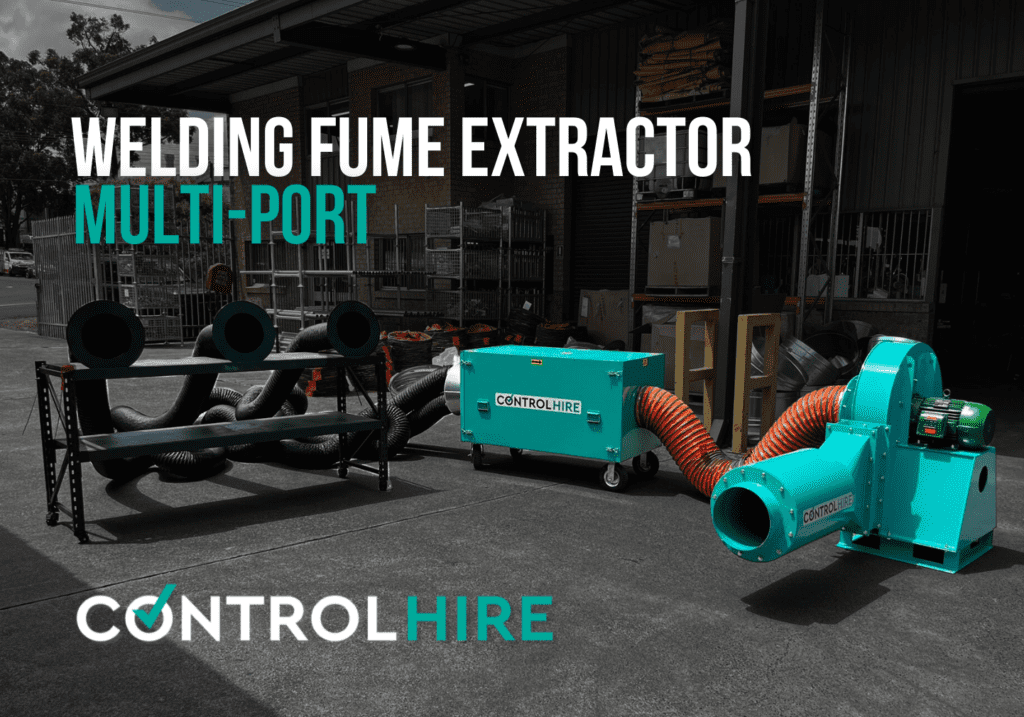
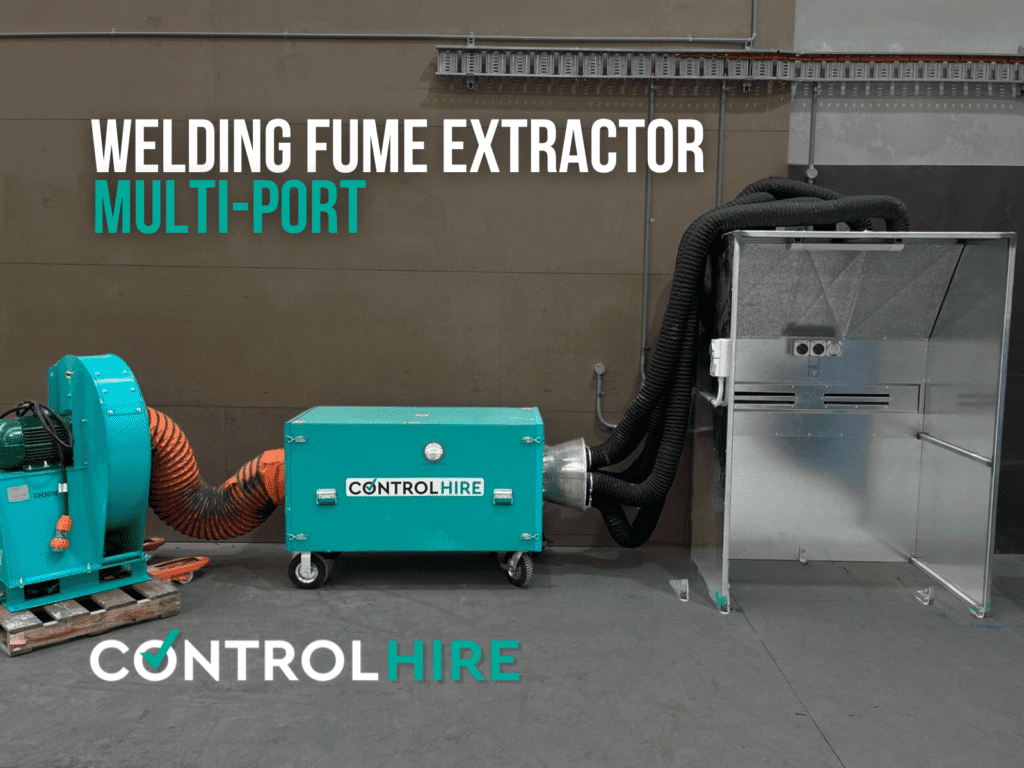
Control Hire’s Multi Port Welding Fume Extractor was designed specifically for these high demand scenarios. Rather than deploying separate extraction units for each workstation, this system provides centralised fume capture and filtration for up to four welders from a single kit.
The system includes a H 510mm centrifugal fan delivering 8,500 m³/hr of airflow, a 5,000 m³/hr air scrubber with 3 stage HEPA and carbon filtration, exhaust ducting and fume hoses, and individual welding fume hoods for each arm. Options for 1, 2, 3 or 4 arm configurations mean it can be scaled to match the number of active welders on your job.
The 3 stage filtration process captures hazardous particulate including metal fume and fine dust, helping to bring exposure levels well within the new 1 mg/m³ standard. Filtered air is scrubbed before being returned or exhausted, depending on site requirements.
Where It Works Best
This kit is already being used across a range of environments including tunnel, rail and shaft welding operations where natural ventilation is limited or non existent. It is also well suited to confined space fabrication, structural steel welding on major civil and infrastructure projects, workshops, warehouses and production lines, and assembly and manufacturing facilities.
In tunnel and underground environments in particular, fume management is critical. There is no ambient airflow to dilute contaminants, and workers are often operating for extended shifts in close proximity to the weld plume. A centralised extraction system with dedicated hoods at each workstation ensures fumes are captured at the source before they enter the breathing zone.
The December 2026 Deadline
The transition from WES to WEL is not just a rebrand. The new framework involves a systematic review of limit values against current health evidence and alignment with international best practice. For welding fumes, this means the 1 mg/m³ limit is here to stay and enforcement is expected to ramp up once the WEL regime formally takes effect.
Engineering control upgrades take time. Design, procurement, installation and commissioning for ventilation and extraction systems can take months. Starting this process late in 2026 is a risk that most projects can’t afford, particularly when demand for extraction equipment and engineering contractors is likely to spike as the deadline approaches.
Hire Instead of Buy
Not every project needs a permanent extraction system. For construction sites, shutdown work, short term fabrication jobs or projects with changing layouts, hiring makes more sense. You get a fully maintained, compliant system delivered to site without the capital outlay, and you can scale up or down as the job requires.
Control Hire supplies the Multi Port Welding Fume Extractor from branches in Sydney, Melbourne and Brisbane, with delivery available across Australia. Our team can help spec the right configuration for your site and provide guidance on meeting the updated exposure standards.
Get Ahead of the Change
If your site involves welding in any form, now is the time to review your fume controls. The 80% reduction in permissible exposure is significant, and the enforcement environment heading into December 2026 is only going to get tighter.
Talk to our team about hiring a Multi Port Welding Fume Extractor for your next project.