
As of September 1st, 2024, Safe Work Australia has published amendments to the model Work Health and Safety (WHS) Regulations which increases protection for workers at risk of exposure to silica dust across all industries, including building and construction. Read on to find out what this means for you and your workplace.
What is Safe Work Australia?
Safe Work Australia is the national policy body representing the interests of the Commonwealth, states and territories, as well as workers and employers. They work to achieve healthier, safer and more productive workplaces through improvements to work health and safety (WHS.) Safe Work Australia develops, evaluates and, if necessary, revises national WHS regulations and workers’ compensation policies and supporting strategies.
What is respirable crystalline silica?
Crystalline silica is found in sand, stone, concrete, granite, tiles brick and mortar and more.
Silica dust particles are spread during processes such as: Digging, crushing, cutting, drilling, grinding, sawing, polishing and more. The dust is so small it can be invisible to the human eye. Once inhaled, it can cause:
-Silicosis
-Lung Cancer
-Kidney Disease
-Emphysema
What is a w.e.s?
A workplace exposure standard (WES) represents the concentration of an airborne hazardous chemical/particle within a worker’s breathing zone that should not cause adverse health effects or undue harm.
Compliance with the WES is required under Commonwealth, State and Territory Work Health Safety laws.
What is a T.W.A?
A Time-Weighted Average (TWA) is the average exposure to a hazardous particle/chemical over a certain time period.
What is the Time-Weighted Average (TWA) Workplace Exposure Standard (WES) for Respirable Crystalline Silica?
Limit: 0.05mg/m³ over an 8-hour period.
High Risk: 0.025mg/m³ over an 8-hour period.
What has changed in the regulation amendment?
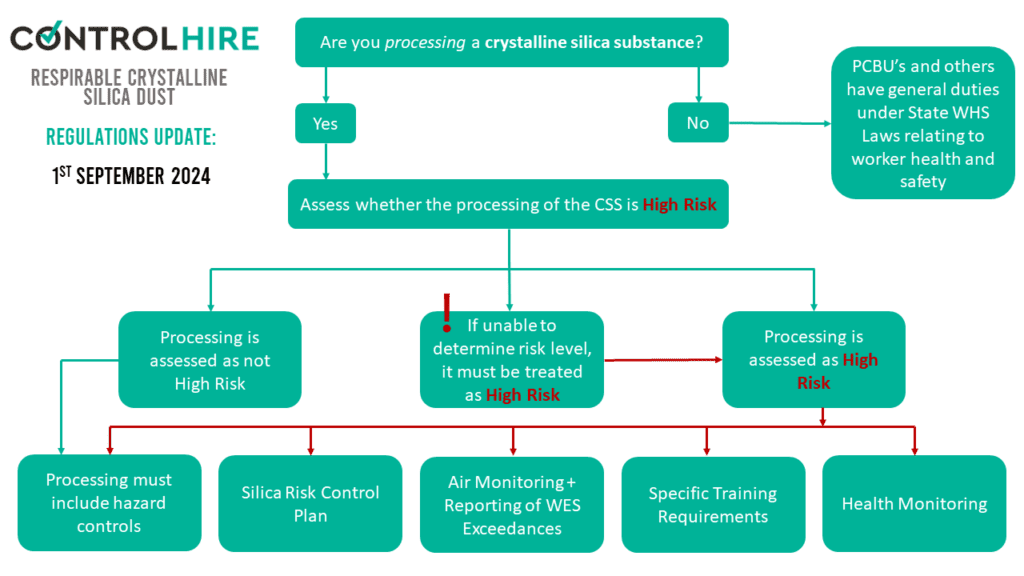
Safe Work Australia’s regulation and amendment includes the clarification of:
1. Crystalline Silica Substances (CSS)
A CSS is any materials containing over 1% Silica, including, but not limited to:
Engineered Stone (Up to 97%)
Sandstone (70~90%)
Granite (25~60%)
Ceramic Tiles (5~45%)
Autoclaved Aerated Concrete (20~40%)
Slate (20~40%)
Concrete (Up to 30%)
Porcelain (14~18%)
Brick (5~15%)
Marble (up to 5%)
2. The range of Processing activities:
Including, but not limited to: Excavating, drilling, cutting, mining, quarrying, tunnelling, processing, cutting, demolishing, blasting, casting, grinding, hammering, chiselling, fracturing, crushing, loading, hauling, dumping sweeping, blowing.
3. Assessing whether the processing of the CSS is High Risk:
A Person Conducting a Business or Undertaking (PCBU) at a workplace must assess the processing of a CSS carried out to determine if the processing is High Risk.
In assessing whether the processing of a CSS is high risk, they must have regard to the following:
(a) the specific processing that will be undertaken;
(b) the form or forms of crystalline silica present in the CSS;
(c) the proportion of crystalline silica contained in the CSS, determined as a weight/weight (w/w) concentration;
(d) the hazards associated with the work, including the likely frequency and duration that a person will be exposed to respirable crystalline silica;
(e) whether the airborne concentration of respirable crystalline silica that is present at the workplace is reasonably likely to exceed half the workplace exposure standard;
(f) any relevant air and health monitoring results previously undertaken at the workplace;
(g) any previous incidents, illnesses or diseases associated with exposure to respirable crystalline silica at the workplace.
In assessing whether the processing of a CSS is high risk, the person must not:
(a) rely on the control measures to be implemented
(b) have regard to the use of personal protective equipment and administrative controls used to control the risks associated with respirable crystalline silica.
The person must ensure that the risk assessment conducted is recorded in writing.
If a person conducting a business or undertaking is unable to determine whether the processing of a CSS carried out at the workplace is high risk, the processing is taken to be high risk until the person determines that the processing is not high risk.
When the processing is Assessed as High Risk:
Once the written assessment is recorded and completed, if the risk is classified as High Risk, the PCBU must comply with:
A Silica Risk Control Plan
Before initiating any High Risk CSS processing, the PCBU must prepare, record and execute a Silica Risk Control Plan. This must outline what dust control measures will be implemented, monitored and reviewed. The plan must be available to all workers prior to work commencing.
Duty to Train Workers about the Risks
The PCBU must ensure that any worker involved in (or at risk nearby) the CSS processing has completed an Accreddited Crystalline Silica Training in relation to:
(a) the health risks associated with exposure to respirable crystalline silica;
(b) the need for, and proper use of, any risk control measures required by the Regulations.
A record must be kept and available for inspection under the Act.
Air Monitoring
The PCBU must also undertake air monitoring to ensure the WES Exposure Limit (0.05mg/m³ over an 8-hour period) is not exceeded. If any the WES Exposure Limited is exceeded at any time the PCBU must provide the air monitoring results to the Safe Work Regulator as soon as reasonably practicable but not more than 14 Days from the exceedance date.
Health Monitoring
The PCBU must provide ongoing Health Monitoring for all workers at risk, implementing valid techniques to detect any detriment to the workers health and if the corresponding cause is the associated exposure to the hazardous particle/chemical.
What Control Measures can I implement to protect myself/my colleagues/my workplace?
Safe Work Australia recommends following the Hierarchy of Controls, including:
Substituting the hazard,
Isolating the hazard/person
Minimizing the hazard via Engineering Controls
What Products can help?
Control Hire is Australia’s Temporary Hazard Control Experts, and we specialise in utilizing hazard control to reduce the risk in your work site:
Air Monitoring is made easy with our Real-Time Respirable Silica Dust Monitor.
Isolate and Encapsulate your High Risk areas with a Mobile Cutting Station.
Filter/Extract the air in your workplace with our various Air Scrubbers & Fans.
Suppress the dust particles in the air with our Fog Lance or Dust Cannon.
Ventilation Plans for your project.
Control Hire can provide a free consultation and visit your worksite to help you pinpoint and control any hazardous areas: